What Jackets Look Good on Plus Size Men?

What jackets look good on plus size men? If you have asked that in a fitting room, you may have heard “it fits fine” while the shoulders drooped and the hem sat right on your belly.
Most guys with a bigger frame have been there. The problem is rarely your body. Nobody told you what to check.
This guide shows you how to pick and fit a jacket in 10 steps. You will take 3 measurements, choose a style that suits your build, and run a fit test you can do in any store mirror.
By the end, you will own one jacket that sits right on your shoulders, closes without pulling, and ends where it should.
Fit Guide
Four checks. Shoulders first.
-
Shoulders first
Line the seam up with the edge of your shoulder bone. A tailor can shorten sleeves, but shoulders are hard to fix, so this check comes before everything else.
-
Close it, no X
Fasten the front. An X-shaped crease at the button means it is too tight. A flat hand should slide under the front with no fight.
-
Find your hem
Aim for the belt line to about 2 inches below. Blazers should cover your seat. Skip cropped jackets. They stop right at the widest part of your middle.
-
Dark, solid, mid-weight
Choose navy, charcoal, black, or olive in a mid-weight fabric with 2% to 5% stretch. One color draws one long line down your body.
Measure your chest, shoulders, and stomach

Tag sizes change from brand to brand, but inches do not. Wrap a soft tape around the fullest part of your chest, under your arms and across your shoulder blades.
Keep it snug, with room for one finger. Measure your stomach at its widest point, then your shoulders from bone to bone across the back.
Write down all 3 numbers. Do not suck in. The jacket has to fit the real you. (No soft tape? Lay a piece of string around the spot, then hold it flat against a ruler.)
Choose from the jackets that look good on plus size men

Five styles do the most work on a bigger frame:
- Unstructured blazer. Soft shoulders and thin padding, so it drapes instead of boxing you in.
- Field or chore jacket. Hip length, a straight cut, and flat pockets that add no bulk.
- Harrington jacket. A clean collar and a plain front keep the lines calm.
- Plain leather or faux leather jacket. Pick one with few zips and snaps.
- Knee-length topcoat. It draws one long line from shoulder to leg.
Skip cropped jackets and tight ribbed hems. They stop at the widest part of your middle and point right at it.
Pick a dark, solid color for your first jacket

Want a jacket that works with clothes you already own? Start with navy, charcoal, black, or olive. One dark color draws a single long line from shoulder to hem, and the eye follows it up and down instead of side to side. Big checks, wide horizontal stripes, and shiny fabrics add width, so save them for later.
Check the fabric for weight and a little stretch
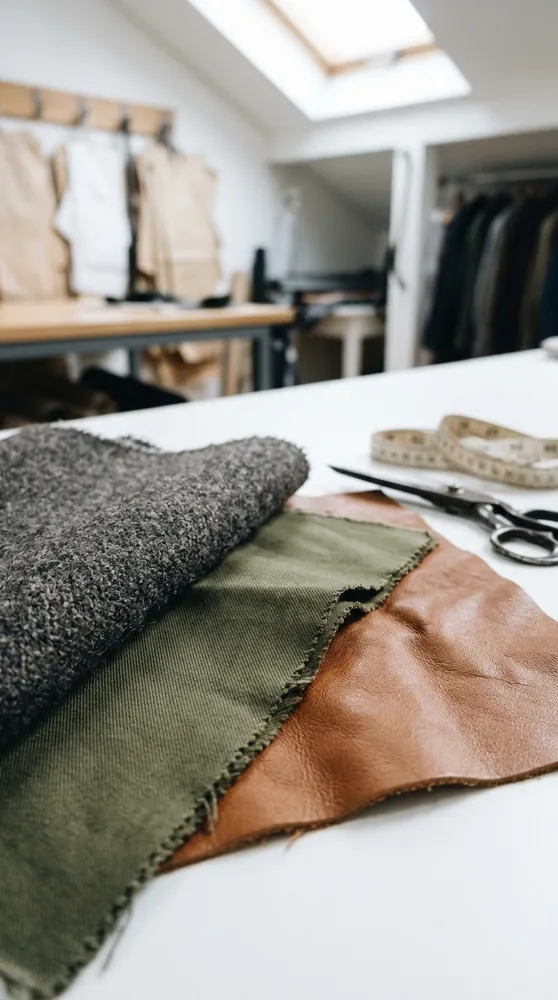
Fabric decides how a jacket hangs, long before the cut does. Look for wool blends, cotton twill, or soft leather in a mid-weight, about as thick as a good pair of chinos.
A label that lists 2% to 5% elastane adds room to move. Thick puffy padding adds bulk, and thin knits cling to every curve.
Pinch the fabric and let go. If it springs back flat, it will hold its shape all day. (On a budget? Thrift stores often carry wool blends for less.)
Wear your usual shirt and shoes to the fitting

A jacket that fits over a thin tee can pinch over a sweater, so test it the way you will wear it. Bring the thickest layer you plan to put under it, plus the pants you will pair it with.
Line up the shoulder seam with your shoulder bone

If the seam droops down your arm, the jacket is too big. If it climbs toward your neck, it is too small. You want it to sit right at the edge of your shoulder bone, where your arm begins. Stand tall with your arms relaxed, and check both sides in the mirror.
Fasten the front and look for pulling

A tight jacket tells on itself. Button a two-button blazer at the top button only, or a three-button blazer at the middle one. Zip casual jackets all the way up.
Look for an X-shaped crease around the button. That X means the fabric is pulling. A flat hand should slide under the closed front without a fight.
If the shoulders fit but the front pulls, try an extended or big and tall cut in the same shoulder size.
Check where the hem ends

A hem that stops at the widest part of your stomach points straight at it. Stand with your arms relaxed and curl your fingers.
A blazer hem should land near your curled fingertips and cover your seat. For casual jackets, anywhere from your belt line to about 2 inches below it works. Too long, and your legs look shorter.
Check that the sleeve ends at your wrist

Let your arms hang at your sides and look in the mirror. The sleeve should stop at your wrist bone, with about ½ inch of shirt cuff showing. Too short makes the whole jacket look a size too small.
Test the jacket by moving in it

Stores let you stand still. Real days do not. Run through these before you head to the register:
- Raise both arms to shoulder height.
- Cross your arms in a hug and feel your back.
- Sit on a bench for 10 seconds.
- Reach forward like you are holding a steering wheel.
The hem should stay below your belt, and nothing should pull tight across your back.
You now know what jackets look good on plus size men, and you can prove it in any fitting room.
Shoulder seam on the bone. Front closed with no X. Hem at the belt line. Sleeve at the wrist. That is the whole check.
Next, build one outfit around your new jacket: dark jeans, a plain tee, and clean sneakers.
Save this pin so the checklist is in your pocket at the store.